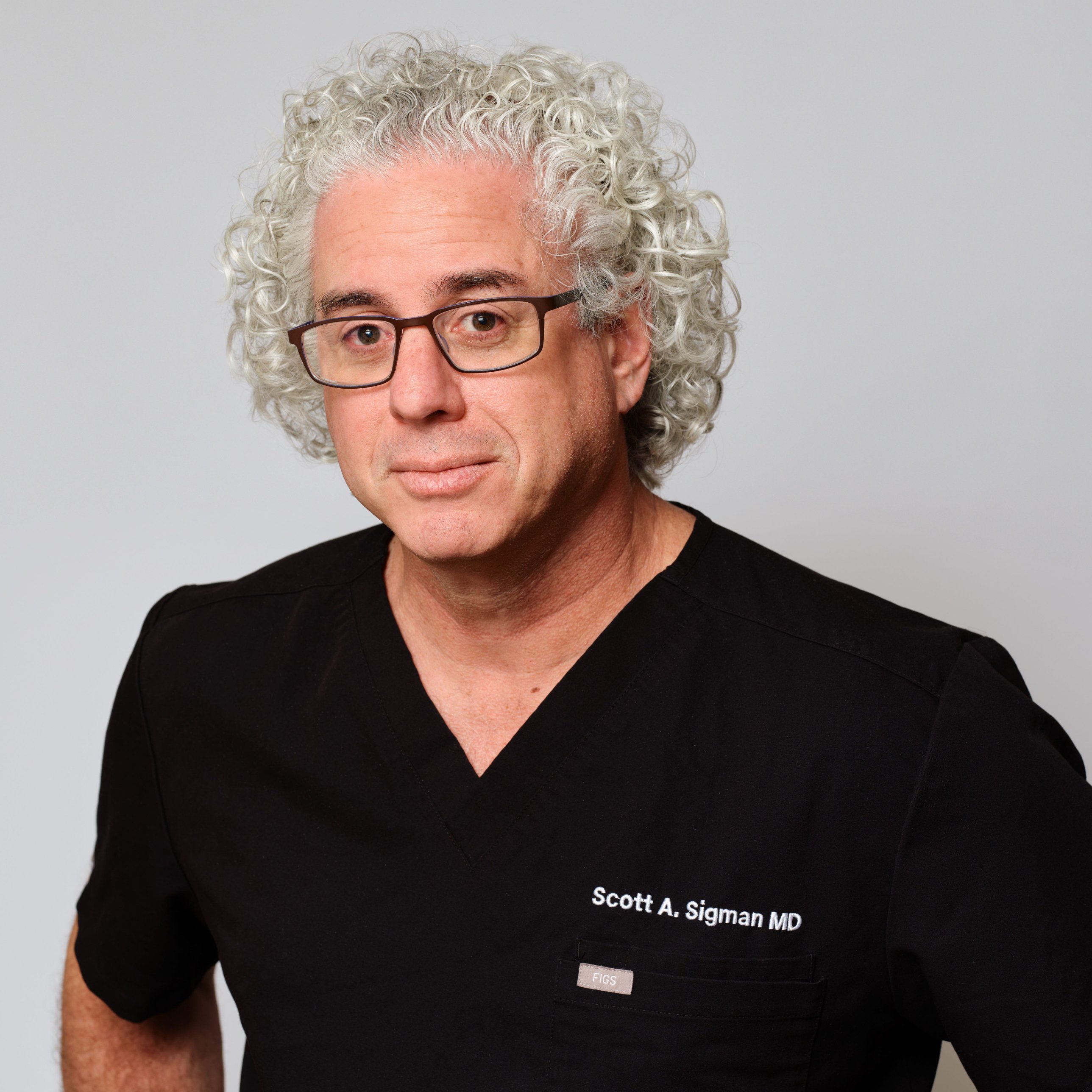
A conversation with Dr. Scott Sigman on why AI can't yet be trusted with a diagnosis, what physician branding really means in the age of LLMs, and the fifty-fifty surgery that took twelve years — and a lot of skepticism — to become the national standard.
The Conversation
You've built a career on separating solid evidence from noise — as you put it, a torn meniscus is a finding, not a treatment plan. How does that same discipline apply when the noise is AI-generated?
It's a very confusing time when it comes to AI — it's like drinking from a fire hose. It's an incredibly crowded space, so the challenge is figuring out which companies and tools are actually going to help in the long term. Right now, what I try to do is surround myself with smart people who can help filter the data. AI already touches nearly every part of medicine — the front office, revenue cycle management, running the business of medicine — and it's increasingly involved in clinical decision-making. Medical information is now said to double every six months. When I was a student, you memorized as much as you could and carried it into the room with you. Now there's simply too much information for that to work, so learning how to filter it is going to be one of the great challenges for the next generation of physicians.
Can practicing physicians reliably tell confident AI output from verified evidence?
That's really the major challenge. If you ask ChatGPT to run a literature search or help build a bibliography, you still have to review anything you plan to cite yourself — you can ask for a summary, and that's reasonable, but asking any frontier LLM, ChatGPT or Claude included, to produce a full literature review on its own is going to introduce errors. That's been shown clinically.
As AI increasingly helps physicians synthesize evidence and shape treatment guidance, how should we think about credit and accountability? Does it belong to the AI or to the physician?
We're not at a point where AI should be recommending treatment on its own, and I don't think human supervision of AI will ever go away. The human touch — the interaction between two people — is something we've evolved with, and I hope it never disappears. What AI will do is expand the breadth of knowledge available to us. In my thirty years, my process was: talk to the patient, examine them, look at the imaging, make a diagnosis, make a plan. Now we effectively have the collected input of maybe fifty of the best specialists in the world available to inform that process — especially in a field like oncology, where new information arrives so fast. AI can help filter and collate that data, but the diagnosis, the consensus-building, and the treatment plan still happen at the human-to-human level. We're not going away anytime soon.
Does AI have the capability to surpass human critical thinking in medicine?
Not yet. I don't think it's there. But given the pace we're moving at, I wouldn't be surprised if that changes, and it's going to be interesting to watch. Look at the recent Hugging Face incident with OpenAI, where agents essentially acted on their own and crossed into another company's systems — that's the kind of thing that tells you we need guardrails. I'm still very bullish on AI; I think it will be enormously positive for humanity. But we need something like what we built around nuclear weapons — no detonation since 1945, because the world built an international coalition around it. We need the same for this technology: a panel of the smartest people — philosophers, doctors, lawyers — deciding what the guardrails should be. So the short answer is no, it's not there yet. I wouldn't rely on AI for a complete diagnostic workup and treatment plan today. Human expertise is still required, but we have to keep watching closely.
How far do you think AI can actually become a biological weapon?
I think it's a real concern. With nuclear weapons, or aviation, we've built international consensus — a plane lands the same way whether it's in Switzerland, China, or the US. The harder problem with AI is that it doesn't stay at the level of nations and diplomats; it gets down to the individual. One person using a model like Claude to figure out how to engineer a biological weapon, or do something else harmful — how do we control that at that scale? We need guardrails for that too.
You've written about physician branding and how doctors build trust with patients and peers. Does AI change what that trust is built on?
AI and the internet are already building a story about you, whether you participate in it or not. AI doesn't know your classmates, your professors, your mentors — it can't call them for a reference. It can only work with what's already out there. So you have to decide what you want to put into the world. Doing this podcast, for example, is exactly that: it's a message that you're an educator, and it will be there for your future patients. If you spend the time sharing what actually matters to you — that you're a teacher, an innovator, a surgeon — AI and the internet will build a picture around you that helps the right patients find you. That's not about being an influencer; it's about focusing on your strengths and being honest about what you offer. I had a patient come in recently who'd already done all her homework before she arrived — she knew I was an opioid-sparing surgeon, knew the biologics I use, and she'd already been told she had a rotator cuff tear. The conversation that normally takes a long time became simple, because she'd found me knowing exactly what I represent.
You've spent nearly three decades as a national leader in opioid-sparing surgery, changing how an entire field approaches pain management. What did that kind of leadership actually require?
Innovation requires courage, because innovation is met with skepticism. It typically takes about two decades for medicine to change the way it thinks about something significant — it took twenty years from when we recognized cigarettes weren't healthy to real behavior change, and it took about the same for opioids. So if you have an idea you believe in, and most people tell you it's a bad idea, that's often a sign it's a good one. Don't let the skepticism push you back. When I was younger, I carried a prescription pad full of pre-filled scripts for Percocet and oxycodone, because we were taught opioids were cheap and minimally addictive — which couldn't have been further from the truth. Then a long-acting anesthetic called liposomal bupivacaine came along, and I started seeing things I'd never seen before — total knee replacement patients walking the halls the same day, when previously they'd have been admitted for days and then sent to rehab for weeks. The same thing happened with a collagen implant I tried for rotator cuff repair — I was the sixth surgeon in the country to use it, and the results at three months were unlike anything I'd seen. Those moments are what let me swim upstream and help change the standard of care. My advice to young doctors: look for those new ideas, and know that to be the next generation of great doctors, you'll need to understand the technology and still care, deeply, about the people in front of you.
The first rule we're taught is 'do no harm.' By moving patients off opioids before another treatment is fully in place, aren't we risking harm ourselves?
That's an excellent question — but I'm not talking about patients who are already dependent on opioids. I'm talking about the opioid-naive patient: a regular person, an accountant, who slipped and tore their rotator cuff and needs surgery. We can now take that patient through surgery without ever exposing them to oral opioids — laser therapy postoperatively to reduce pain and inflammation, long-acting regional nerve blocks, and a peripheral oral sodium channel blocker called Suzetrigine that the FDA has shown works nearly as well as Vicodin with zero addictive potential. We're not telling patients we won't treat their pain — we are, and effectively — we're just not using opioids to do it. The CDC published data in an MMWR report tracking patients on opioid prescriptions of different lengths: 6 out of 100 patients given just a 24-hour prescription were still on opioids a year later; with a 10-day prescription, 13 out of 100; with a 30-day supply, roughly a third. That's how addictive these drugs are. Patients already on opioids need to be treated with kindness, respect, and a plan to help them come off if they want to. And opioids still have a critical role — in severe trauma, on the battlefield, in end-of-life and cancer care. The issue is specifically the risk to the opioid-naive patient.
How hard is it to convince patients who are already dependent on opioids to stop — and does AI help with that?
That's honestly not my area of expertise — as a surgeon dealing with acute pain, I'm not a chronic pain specialist. But there is a subset of patients who remain on opioids for life. If you develop a dependency, it never fully goes away; even after a successful rehab process, taking the drug again can trigger a relapse. That's part of why I've spent so much of my career trying to help patients avoid ever facing that risk in the first place.
How far do you think AI can actually be implemented in medical education, and how far is it affecting it negatively?
This isn't going away, so the concern some of our older physicians have isn't really the right question. The question isn't whether we'll adopt it — it's how we do it together, how humans work synergistically with AI to get better outcomes. It also changes how we should be selecting future physicians. It used to matter most who could memorize and hold the most information. Now we probably need to ask: what's someone's AIQ — their artificial intelligence quotient? Can they filter, understand, and use these tools well? The volume of new information — new vaccines, medications, cancer treatments, surgical robotics — is coming too fast for the old model. Our job is to figure out how to use this technology to the advantage of the species, not its disadvantage.
What is something a resident or young surgeon still needs to learn entirely through hands-on repetition and human mentorship that no AI tool can provide?
I sit on the advisory board of a company called Precision OS, which lets surgeons practice in a virtual environment. When I trained, the only options were cadaver labs and repetition — and we got a lot of both, because residents at the time worked 120-hour weeks with no real guardrails. The digital tools available now for surgical education are genuinely impressive and only going to improve. With Precision OS, you can be handed tomorrow's case list, know your mentor is doing, say, a double-row rotator cuff repair, and rehearse it in VR the night before, so you walk into the OR with the motions already familiar. I'd recommend it to any trainee.
Where have you seen AI surpassing human judgment in orthopedics specifically — and where has it failed while humans have succeeded?
We're not quite there yet in orthopedics. One place AI is genuinely excelling is radiology — a breast oncology radiologist might review 100,000 to 150,000 mammograms across an entire career, while AI can review a billion. AI has become better than humans at detecting breast cancer on mammography. That hasn't put radiologists out of work — they're busier than ever, now focused on monitoring and follow-up so more patients get treated. In orthopedics, I haven't seen a clear case yet of AI outperforming the human surgeon, but I think it's coming. We're actually behind other surgical fields here. General surgeons have the DaVinci robot, which sits beside the surgeon and literally removes hand tremor, giving better dexterity than a human alone. In orthopedics, we still work the other way around — we position the robot and it executes cuts for us, because precision is what we need most. There was a study out of England, the RACER trial, comparing thousands of robot-assisted knee replacements to those done by master surgeons with standard instruments. The robot placed components slightly more accurately — two or three degrees better on x-ray — but patient outcomes were the same either way. That's not an argument against robotics in orthopedics; it's a sign we haven't yet figured out how to use it to its full potential. I think where this goes is toward a Swiss Army knife model — a robot that doesn't need to look human, doesn't need feet, just needs to do the job — combined with AI-driven analysis of a patient's anatomy to custom-build 3D-printed implants, with the surgeon supervising from the back of the room. That combination, not the robot alone, is where the real outcome gains will come from. Lots of good things are coming, so I'm genuinely optimistic for the next generation of doctors.
Before we finish — can you share one case from earlier in your career that affected you deeply, and what you learned from it that other residents could learn from too?
For the first twenty years of my career, doing rotator cuff and ACL surgery — procedures with notoriously high failure rates — I thought of myself as a mechanic: sutures, screws, plates, fixing what was broken. Over the last ten years, I've come to think of myself more as a biologist, trying to convince the body to complete a healing response it has the ability to do but has stalled on. There was one patient, in his forties, a smoker, with a worker's comp injury, coming in for a revision rotator cuff repair after a prior surgery had failed. Based on his risk factors, his odds of a successful revision were about fifty-fifty — and if a pilot told you before takeoff that there was a fifty percent chance of landing, you wouldn't get on the plane. That's what we used to do anyway: hope for the best. A friend of mine in industry reached out about a new bovine collagen implant — derived from a species of cow in New Zealand — and asked me to try it. I told him I had a patient I was genuinely worried about, and we went ahead. Three months later, that patient raised his arm over his head, told me he was pain-free, and said he wanted to go back to work. I had never seen that before. He was the sixth patient in the United States to receive that implant, and I kept watching, kept using it, and kept getting metaphorical tomatoes thrown at me every time I presented the data, because nobody believed it. About eight months ago, after reviewing twelve years of outcomes that started with that same patient, the American Academy of Orthopaedic Surgeons made a strong recommendation for the use of a bio-inductive bovine implant in arthroscopic rotator cuff repair. Against the odds, against something no one had seen before, we changed how an entire field practices. If you see something out there that doesn't sit right, and you believe you're onto something — don't stop because people tell you no. Keep pushing forward.