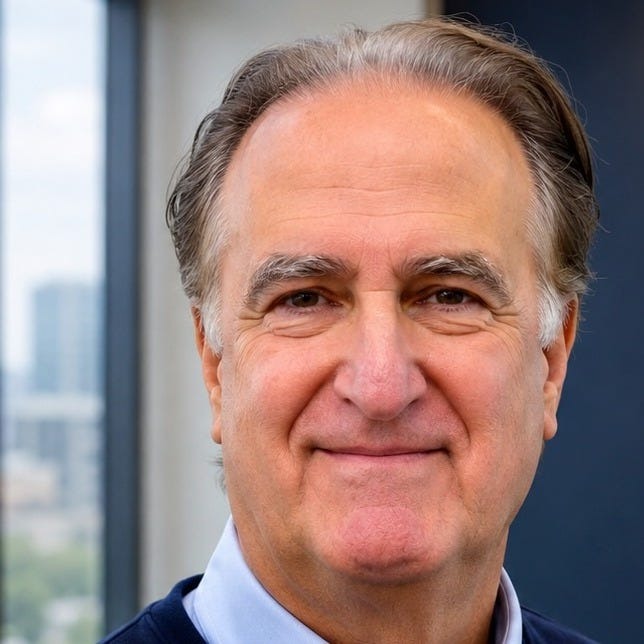
A conversation with Dr. Robert Feinstein on why psychiatry and neurology are not the same field, why every mental illness is biopsychosocial, and why most patients need someone to talk to rather than a prescription.
The Conversation
To begin, could you introduce yourself to our audience?
Sure. I'm Dr. Robert Feinstein, a professor of clinical psychiatry at Northwell Zucker Hospital on Long Island. I've been an academician in psychiatry for over 40 years, holding positions as director of residency training at New York Medical College, senior associate dean of the medical school at the University of Colorado, vice chair of psychiatry at Colorado, and vice chair of education at Dell Medical School. I specialize in education, personality disorders, suicide and violence prevention, wellness, and integrated primary care.
I've also been in private practice for 40 years, treating a wide range of patients, including those with personality disorders, which is my subspecialty, as well as anxiety, depression, bipolar disorder, ADHD and other conditions. I've also recently developed a new online CME education company, with certification in psychiatry and in the psychotherapies, and we have a number of new offerings coming this fall.
A well-known physician said on a podcast that there is no real distinction between psychiatry and neurology. Do you agree, or is something lost if we collapse the two fields into one?
I think they have to be considered very different fields. There's a lot of overlap, in that both are focused on the brain, but the level and kind of intervention are completely different. Neurologists do a neurologic exam and neurologic testing. Psychiatrists do a detailed evaluation, but they also provide psychotherapy, which is a totally different field. I also think there's a distinction between the brain and the mind.
The analogy I'd draw is a watch and time. A watch will tell you what time it is, but it won't tell you the experience of time. Psychiatry is dealing with the mental aspects of the brain, which neurology doesn't cover at all.
What, then, is the difference between the mind and the brain?
The mind is much more of a concept about the brain, in the same way that time is a concept about the watch. There are many different theories about how the mind works, some of which have no neuroscientific explanation, because they're conceptual and have to do with how you understand the way the mind works. We're not at a level where we can link those discussions between brain and mind very well yet. That's where people would like to go, to link them as though they're inextricable, but they're really not. They're two different levels of conceptualization.
After decades of training in psychodynamic and relational approaches, how do you reconcile therapy that treats meaning and relationship with the view that the real disease is ultimately biological?
I think it's a false dichotomy. All mental diseases are biological, and they're also psychological, social and cultural. You can't say it's one form of disease. It's a process of thinking about people in a complex way, on multiple levels, and those levels aren't equivalent. Trying to condense psychiatric illness into biology alone is a giant mistake, especially since the biologic treatments don't work for many psychological problems. We need other things as well: psychotherapy, social interventions and public health interventions.
If a patient's symptoms are ultimately traceable to a biological process in the brain, does that change how much we should rely on insight-oriented therapy versus direct biological intervention?
I think that question overestimates the biology. Take depression. Some parts of depression have biological causes, and we might say a bipolar depression has a biological cause. But the causes of depression are heterogeneous. Depression can be triggered by a loss: a loss of prestige, of self-esteem, of a loved one, of a job. We're hard-pressed to call those situational experiences a biologic illness. They're psychosocial issues.
You've written about violence in outpatient mental health practice as a quiet risk clinicians don't talk about. Can you share a case, without identifying details, in which you were the one in danger?
There are many cases where violence occurs. One was in a psychiatric emergency room, and it was threatened violence that never actually occurred. A patient with a history of domestic violence had been brought in by police in the Bronx. He was a former Green Beret with a ninth-degree black belt in karate, and the police were afraid of him, as was I. Eight officers surrounded him and asked me to take care of him. I offered him medication, and when he walked toward me while I was holding it, I was frightened enough that I backed up all the way across the emergency room and sat down. Fortunately I was not attacked. He took the medication, calmed down, and we were able to admit him to the inpatient unit.
I had another case where I was actually assaulted, by a woman in a wheelchair who had come from a nursing home. She was probably demented and speaking very low, so I leaned down to hear her better. She grabbed me by my tie and almost gave me a concussion by hitting me over the head with her cane.
Violence in ER settings is really common, and violence in outpatient settings is far more common than we like to talk about, partly because of guns and weapons, which many patients in America carry.
Psychiatrists are trained to hold immense difficulty for others, yet doctors are not immune to becoming patients. Have you or a colleague crossed that line from treating to needing treatment, and what was the transition like?
Many psychiatrists, because of the vicarious trauma of working with patients or because of their own trauma, do enter treatment. About a third of psychiatry residents now seek psychotherapy as part of their training. I generally recommend it for two reasons. It helps them manage the profession, and you're a better psychotherapist when you've been in psychotherapy yourself, because you understand more of the ins and outs. Some training even requires it: to become a psychoanalyst, one of the requirements is to be in your own analysis. The thinking is that the best way to train as a therapist is the core triad of your own treatment, treating other patients, and supervision.
Was there a moment when a patient's crisis revealed something about your own vulnerabilities as a clinician that you hadn't fully faced before?
Most of that has to do with patients confronting serious, life-threatening illnesses. I've had a few serious life-threatening illnesses of my own, so when patients discuss theirs, it has an impact on me, because I've had those issues to deal with myself.
Is there a case that touched you and taught you something about your work?
I'll share one that taught me a lot about what it takes to develop an alliance with a patient. He was a coach and teacher who came to see me because his wife had been hospitalized for about a month with probable schizophrenia. He had a newborn child, and his mother, who had dementia, was living with the family. He was very traumatized by his wife's hospitalization and by the demands of caring for an infant by himself, and he came in with anxiety and depression. When I tried to talk to him about his feelings, he couldn't access them. All he could talk about was his job and the mechanics of daily living.
At the end of about the fourth session, when I really couldn't connect to him, there was a huge rainstorm with thunder and lightning. From my home office I watched him drive to the end of my driveway and get stuck. I went out with an umbrella and realized a tree was blocking his car. He rolled down the window and said he had to get home to his baby and his mother. So I put on a raincoat, took a chainsaw out of my garage, and cut the tree in half to let him out. As he left, he said, "I see, Doctor, that you do other things." We both laughed.
When he came back for the next session, he completely opened up. He trusted me, and he could really talk about what was going on. He needed a moment of kindness he could feel, and an expression of my own humanity that allowed him to access his. It turned out to be a very successful treatment, one I thought was going to be a failure, because of this inadvertent, unusual episode.
Is it hard to win a patient's confidence in psychiatry?
Some patients, yes, very difficult. The trend right now that I'm really unhappy about is prescribing. In America, 50% of psychiatrists say all they do is prescribe medications. I think that's a huge loss for the field. We have the capacity to do psychotherapy, to do family therapy, to intervene at a public health level, and psychiatry in America is being reduced to prescribing only, which I think is a real tragedy. In a country like Canada they don't have that problem at all: 89% of their psychiatrists are doing both therapy and medication. America is being pushed into the biological realm of treatment as if it's the only form of treatment patients either want or need, and it's certainly not the case.
What is the hardest thing to teach a young psychiatrist about protecting their own mental health while staying fully present for patients in crisis?
It's the issue of self-care. When you see a lot of sick patients, you take their stories home, and they hit you vicariously. So we have residents practice the same things we ask patients to do: develop a relaxation response and practice it, typically something like mindfulness, and cover the basics. Make sure you're exercising, sleeping, have friends, and are engaged in life. We also let physicians know that therapy is available to them, and many take it up. The combination of lifestyle and psychotherapy, if needed, is probably the best intervention we have to prevent trauma in our trainees, and I push that very heavily.
Does the relational complexity of the work blur the line between doctor and patient in non-violent ways, with a clinician starting to absorb a patient's pain as their own?
You're talking about vicarious trauma. Working with patients is a two-part process. When you listen to a patient who has had trauma, you have to be empathetic, and empathy starts where you feel what the patient feels. If the patient is sad, you may access sadness in yourself. If they're having panic attacks, you may access that too. But it's transitory. You only touch it for a minute, and then you have to get outside of that feeling state and mentalize the problem. Mentalizing means helping the patient understand their own intentions and motivations. It's the combination of empathy and mentalization that makes for the most effective therapy, and I think being able to do both minimizes vicarious trauma, because you come to understand what the patient needs, what you need, and what each of your intentions is.
Do happy people with positive emotions ever come to a psychiatrist?
The main application of psychiatry is for illness and pathology, but it's not the only one. I see many people who come to foster their creativity: writers, artists and musicians. They don't come with a psychiatric complaint. They're generally doing well and very successful, but they've hit a block where their creativity is no longer available to them, and they want to reopen it. Analysts do this through free association, where you get a person to say what's on their mind. If you can teach people to truly free-associate, it unlocks a lot of the creative process.
Psychiatry is also used to improve performance, including athletic performance. Some great athletes perform in practice but choke when the game starts, and that's a psychological process. They come with blocks in their performance but don't necessarily have a psychiatric illness at all. They have the normal problems people have and are looking for solutions.
Is there a piece of established psychiatric teaching you've had to unlearn after seeing it fail, or a case you couldn't bring to a successful end?
That's a complicated question. It's hard to determine whether a failure is a personal failure or a failure on the patient's side, and it's almost always a combination. There are some patients you just can't reach. Their needs are more complex than you understand, and they're in territory you've never been in yourself. When that happens, one of the most important things is to acknowledge to the patient that you can't be helpful, and then set up consultations with colleagues. I've had many cases I wasn't able to bring to a successful end for one reason or another, especially patients with severe personality disorders, who often drop out of treatment and need many different ways of being addressed. I've had my share of those failures, not necessarily with bad outcomes, but cases where I needed to refer patients to others with expertise I don't have.
If a resident told you their patient's suffering was becoming indistinguishable from their own, what would you tell them to do, beyond the textbook answer?
The first thing is to understand why the case is failing. If the resident is too close to what's happening, which sometimes occurs when residents have family members with the same diagnosis, that's a common situation. A resident may have a parent or sibling with a severe alcohol problem, then get a patient with a severe alcohol problem, and all the anger they feel toward their family member starts to come out against the patient. That's called countertransference. We teach people to identify it, and then at that point you consult with another psychiatrist, or you refer the patient.
Where do you draw the line between ADHD as a distinct clinical entity and ADHD as a cluster of symptoms that overlap with anxiety, trauma and mood dysregulation?
Both of those things are true. There is ADHD in isolation, and there is ADHD with a host of comorbid conditions, and you have to sort that out, which isn't always easy. Sometimes anxiety and depression can look like ADHD. For that we usually do neuropsychological testing, including computer-based tests of memory, attention and focus, and there are rating scales to track symptoms over time. Then you apply the diagnostic criteria. The comorbidity between ADHD and other disorders is very high, around 40 to 50%, so you're usually treating more than ADHD alone. But there are patients who have just ADHD and nothing else.
How do we define personality disorders and identity problems, for example when a person says they don't feel they belong in their own body?
I think you're describing two things that I can't quite see fit together. Personality disorders are roughly 50% genetic and 50% environmental. According to the DSM there are 11, but there are probably 15 different subtypes. They are characteristic ways of thought, feeling, emotion and behavior that are repetitive, maladaptive and affect psychosocial functioning in the world.
What you're describing is an identity problem, which may be experienced by patients with severe personality disorder. These are people who can't clearly define who they are. They don't know whether to view themselves as a father, a son, an employer or a worker. Their identity is mixed and confused. It's called identity diffusion: they don't have a stable sense of who they are. It runs through all the personality disorders, but more in some than in others.
If psychiatry eventually merges with neurology as brain imaging and biomarkers improve, what do we gain, and what do you worry we could lose, especially for patients who need to feel heard as much as correctly diagnosed?
I think they will merge to some degree over time, with some merging of the biology with the disorders. But it's the same problem we started with: I can't see how the mind would be explained on the basis of biology. We don't even have a detailed formal understanding of what the unconscious is. We can describe its location, but not how it operates, and describing how it operates uses a whole different set of language, describing a process that biology will never meet. So I don't think they'll ever be one and the same. I think there will always be a difference between mental life and biologic life. I don't see how they can ever fuse, although I don't know that for sure.
A patient with a traumatic brain injury can go on to develop psychiatric illness. If the two can't be fused, how can a neurological problem lead to a psychiatric one?
It can be both the neurologic injury and your reaction to it. If you've had brain trauma, that changes your brain functioning. It makes you more forgetful and gives you symptoms closer to an organic brain syndrome. But then you have a reaction to the loss of those abilities, and that reaction is in the psychological realm, not the neurologic one. It's like patients who become aware they're becoming demented. They're very afraid of the dementia, so they develop anxiety and depression because they know it's coming. That's a secondary reaction to the biologic event, and it operates on a different level. I don't think they fuse that well. I think they operate on different hierarchies of understanding.
What condition have you treated where biology alone could never fully explain what you were seeing in the room, no matter how far brain science advances?
A conflict between a couple is something that doesn't show up in the brain. A problem with becoming a parent doesn't show up in the brain. All the psychosocial problems people live with, the brain manifests them, but it isn't causing them. The brain isn't the origin of them. The origin is the perception of those experiences in the world and how they're processed. The brain does the processing, but the origin is in the external world, and it's displayed in your reaction to those things.
What is one message you would like to leave our residents?
My main message is that psychotherapy really matters. Don't get pushed into the false notion that there's a biologic answer to every problem that comes in the door. Residents have what's sometimes called medication clinic, or do medication management, and that's a terrible understanding of what's going on, because if you think patients are coming in for medication management, then every patient who walks through the door gets medication. About a third to a half of the patients who come in with problems don't need medication at all. They need somebody to talk to. They need someone to understand their conflicts, their problems of daily living, and their health. So keep psychotherapy alive and well. People need conversation. They need to be understood and heard, and for many patients medication is totally being oversold. If you come in thinking you need medication, that's what you're going to give.
My frame for residents is that with every patient you are doing psychopharmacology and supportive psychotherapy. That keeps the two major arms of psychiatry front and center, and you're offering both, not one without the other.