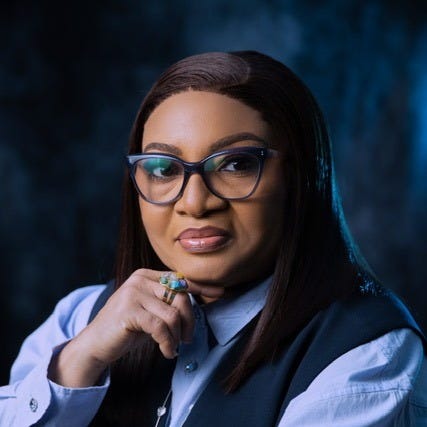
A conversation with Dr. Inyang Takon on why a brain scan cannot diagnose autism or ADHD, why culture shapes what we call a symptom, and why no child should ever be given up on.
The Conversation
To start, could you introduce yourself to our audience?
Thank you for inviting me. I'm Dr. Takon, a consultant neurodevelopmental pediatrician. I've been a consultant for over 22 years in the UK, working in neurodevelopmental pediatrics. Before that, I trained in pediatrics in my home country, Nigeria, and I was a qualified pediatrician before coming over to the UK to do more studies. I did a master's first in community child health, which is neurodevelopmental pediatrics, and then further training here, including neurology and epilepsy, which is one of the major things I do as well.
I see lots of children with varying conditions, ranging from autism, ADHD and tic disorders to fetal alcohol spectrum disorder, and I also run the epilepsy clinic, so I see children with complex epilepsy. I work in the National Health Service in the UK and also independently in private practice. I've hosted the Intervention Matters podcast for the past five years, and I run a channel on Substack called Ask the Developmental Paediatrician.
From a neuroanatomical perspective, what do we actually know about how the brains of children with autism and ADHD differ structurally, and how much of that is solid science versus theory?
There have been lots of studies in the past looking at the brains of children with autism and ADHD. In ADHD, for example, they found some differences in the structure of the areas that regulate attention and organizational skills, but that doesn't necessarily translate into the functioning of the child. That's why we don't send children for brain scans. A lot of those findings are on a research basis, in a population. It's not enough to say that every child with ADHD will have those changes, because some children will have ADHD and won't have them.
For autism, there have also been some differences noted in cortical functioning, but again, it's not enough to say that what you see anatomically translates to clinical functioning. You cannot look at an MRI of a child and say, "Yes, this child is definitely going to have ADHD," or autism. That's why imaging investigations have not taken a forefront in assessing children. They haven't been able to translate into what you see in the clinic when you see the child.
Do ADHD and autism manifest differently in children from different cultures, for example in Europe, the USA or Africa?
It's very important that when we do assessments, we take cultural factors into consideration, because sometimes a child may be wrongly given a diagnosis when we expect the same norms everywhere. In Africa, for example, when children are with an adult, they most times don't give direct eye contact. They don't talk back at the adult, and they wait to be called to talk before they talk. There are several behaviors we consider normal when children are brought up in our different cultures. So before you tell a child that a behavior is a disorder, you need to be clear that it's persisting and that it's much more than you would expect in that community.
The core differences are the same, but the presentations might be different, so you always need to consider the usual patterns of behavior of most children in that culture. In the Western world, eye contact is one of the key things, so people might misinterpret those subtle signs. We cannot use poor eye contact alone to say a child has autism. We have to look at whether it's present alongside all the other behaviors we expect. But the core deficit is the same: a child who is not listening, who needs repeated instruction or a lot of guidance, whose communication is different and atypical, or who prefers to do the same thing all the time and gets very distressed when things change. Those core deficits are still present, and that's what we want to pick out in assessments.
Is there a neurosurgical angle to these conditions, or are they purely developmental and functional?
They're mainly developmental. When we talk about neurodevelopmental conditions, we talk about the soft wiring of the brain as opposed to the hard wiring. The hard wiring is structure: if there's a lesion, you would see it on an MRI. The soft wiring is the connections between wiring, which you don't really pick up on imaging. That's what you tend to have in neurodevelopmental conditions.
But there is an angle, because children with neurodevelopmental conditions such as autism are at increased risk of epilepsy. A lot of autism is thought to be genetic, and some of the genetic predisposition to autism is thought to be the same risk that makes a child more likely to develop epilepsy. We usually highlight that risk to families, especially if the child has more severe autism or learning difficulties. Depending on the type of epilepsy, a child may need brain imaging. If a child has focal epilepsy, where the discharges come from one side of the brain, and hasn't responded to medication, then surgery is sometimes an option. But surgery is an option because of the poorly controlled epilepsy, not because of the autism.
If a child has epilepsy surgery, could that also improve their autism?
You can't say that it will. But for some children it depends on where the focus is. If the focus causing the seizures is around the language area, then when the seizures are controlled, or when that part of the brain is removed, the child may have some developmental benefits, and sometimes those include language and communication.
How do you separate the core features of autism or ADHD from secondary effects such as anxiety or learned coping?
A good developmental history helps us know the onset of the behaviors. When a child has autism, you can tell from the history that the difficulties in development, language and social communication were there from very early on. It's not something that just happened. A child with anxiety, on the other hand, could have been fine from very early on, then something happened or triggered it, and the child starts getting very anxious. That's a situational thing. But that's not to say children with autism don't also have significant anxiety. These things often coexist. A child can have autism, ADHD, anxiety and learning problems, the whole works. When we assess them, it isn't either-or. Most of my patients have two or three conditions coexisting, and it's very common to see that in my clinic.
How are children with several coexisting conditions treated?
That's why we work as a team rather than one person treating the child on their own. A child with autism isn't really "treated," but they may have speech and language therapy, support for learning, and a psychologist if they have anxiety. A clinician like myself would see the child for ADHD and manage their medication and medication reviews. Everybody works as a team, and the school is there to support the child too. Whenever we make a change to a child's medication, for example, we inform the school so they're aware.
How well do the anatomical, surgical and psychological lenses talk to each other in real clinical practice?
We don't tend to request imaging for these children because it's not of any benefit to them. When we do an assessment, it's a developmental assessment. Sometimes a child needs a psychological assessment because we want to see their level of learning. I see the child as one person, but I involve other people when needed. If I feel the child has language needs, I refer to the speech and language therapist. If I feel the child has learning problems, or anxiety or mood problems, I want the psychologist involved. The child's input depends on what the child needs, and I work that out from my assessment.
Some children seem typical at three or four and only start showing autism at six or seven. How and why does that happen?
That's possible. Remember that autism is a spectrum. In some children, things show up very early. In others, during free play, when they aren't put into a rigid structure, the child can be absolutely fine because they're doing what they choose and are under no pressure. When they start school, the demands change. There's more sitting down to learn, more engagement and communication with others, and don't forget transition. Children with autism tend to struggle more at periods of transition, moving from free play to a structured setting with different demands. That's when things may begin to show. We've seen children who looked completely fine initially, and then when they reach school age and start doing work at school, the behavior patterns start to appear.
Should autism and ADHD be called diseases at all, and where do you land on the neurodiversity debate? Does the language change how a child is treated?
We don't call them diseases, because disease means a single cause that you can treat. We call them disorders because they are functional conditions. We look at how much the differences in your presentation affect your day-to-day functioning: your learning, your engagement with others, your ability to interact socially. It's a functional impairment, and that's why we call it a disorder.
The language doesn't change how we treat the child, because we use the standard diagnostic manuals, which refer to disorders. The language has evolved over time. People have called autism a spectrum condition, trying to move away from "disorder" and calling them differences. But it doesn't change how we manage the conditions, because before somebody can be given a diagnosis, there has to be significant impairment. Not everybody who has the traits will have the diagnosis. Some people may have the traits but not be impaired, and you cannot give them the diagnosis. A diagnosis of a disorder means the traits are present in sufficient amount to cause impairment in social and academic functioning.
How much do you use AI in your clinic?
I use AI. In my hospital I'm an AI ambassador. My regular NHS hospital is still going through the debates about adopting AI, but at a national level I'm one of the clinicians looking at the safe adoption of AI, and I've done a lot of training and courses on it. In my independent practice, I use it a lot. I use it for triage: when the patient is able to give me some information, it helps me see the severity and the areas that are most problematic, so I already have a lot of information before I see the child. When I have a large volume of information to go through, it helps me identify patterns and summarize reports.
I also use ambient voice technology to help with documentation, which helps me produce clinic letters fairly quickly. I still check everything. It also helps me put information in a way families understand: it helps me break something down and personalize it, so I'm not giving everybody the same information, and I can generate appropriate information for the child and their condition.
How far do you trust AI in setting up a diagnosis of autism, ADHD or other neurodevelopmental disorders?
AI is not doing the work for me. I'm the one making the diagnosis. AI is just helping to collect the information, and I would never say AI should make a diagnosis for anyone. It should help with gathering information and making sense of patterns. When it summarizes information or shows me certain things, I look at everything. I'm the one who speaks to the patient, takes the history, and makes sense of all that information, so the decision that a child has ADHD or not is mine. I would never trust AI to do a diagnosis, and I'd say the same to other clinicians: it's supposed to help you prepare what you need to form your formulation.
It's also about how parents use AI. Parents use it to ask a lot of questions, and we want them to use it safely, to know the right prompts and what specifically they're asking it to do. It isn't giving you a diagnosis, and that's what we always stress.
You've created apps for families. How far do you trust them to work properly in a patient's hands?
All the apps I created are built from my own information, which I've generated over the years from my teaching and my work on ADHD and tic disorders. I put my information into the AI to create an app that makes it easy for people to look at. It's not AI putting the information there. AI is just helping to make it visible to families. I've tested them with my patients. For example, if I want to explain medication management for ADHD, these are things I've already told them in clinic, but the app helps them sit down and look at the information in their own time, laid out clearly and consistent with what I've said.
I always stress that these apps are not treatment apps. They are educational and informative, and if you have any queries, you should see the doctor.
What do parents most often misunderstand when they first receive a diagnosis for their child?
Many parents think, "This is it for my child, my child is going to be like this forever." We always tell them the child is still growing, and that the child needs interventions and support. They need parents who understand the condition, because when parents understand it, they know how to work with the child. If a child has a language problem, and you teach the parent how to stimulate the child's language, they won't just wait. They can help that child's language develop.
Parents also worry about stigma in their communities. When you diagnose a child, it isn't just the child and the family, it's the extended family and the community. Last week I saw a mother who described how isolated she is because her community misunderstands her child's problems and refers to them as a mental condition. That makes families not want to go out, with a sense of shame or guilt. Sometimes parents think something they did caused this, which is wrong. So we talk to them about their worries and fears, reassure them that nothing they did caused it, and show them the child's strengths and how to communicate those to others in the family.
Is there a case that has touched you?
There was a little boy I started seeing when he was about four, five or six. He was very lively, and it was very worrying. Schools didn't want him because everyone said he was very disruptive and hyperactive. The parents tried different schools, and they kept saying he couldn't sit still. He changed several schools, the parents were very distressed, he was very distressed, and it was upsetting for the whole family. He was diagnosed with ADHD and treated, and honestly, this boy has done so well. I saw him a week or two ago and couldn't believe it was the same child. He had grown into a lovely young man, very articulate, a very good swimmer, doing lots of amazing things. It brought tears to my eyes, because several years ago it was, "What are we going to do? He's not going to be able to stay in school." But with the support of a school that eventually understood and supported his needs, he's done excellently.
I have many of those stories, children I've seen when things were very difficult and there was almost no hope, and then I've seen them again and they've done really well. So it's so important that we do not give up on the children. Everyone is there to support them: the schools, and the parents, who need support to understand the differences too. These children have incredible gifts and strengths, and that's what makes me really happy about working with them.
What message would you like to leave for residents and trainees considering a path in neurodevelopmental pediatrics?
Before I went into developmental pediatrics, I was working mainly in the hospital with acute illnesses. I've written a book called Clinic to Calling, which is coming out by the end of the year, tracing my journey as a pediatrician and how I stumbled into developmental pediatrics. It has given me a lot of fulfillment. It's a specialty where you are with the child for most of their childhood until they become adults, and you have the opportunity to advocate for the child and the family. You can actually see a child change and develop with your help as a doctor, coordinating the support the child needs, finding out exactly what their needs are, and getting other people around them. It's so fulfilling, and it's one of the things that makes me happiest when I see children I've looked after for years getting to adulthood and doing so well. They're children I never knew would be able to go on their own, get a job and do things, and I've seen them doing that.